
Pharyngoplasty for sleep apnea: a facelift for your throat
Barbed reposition pharyngoplasty — BRP — is the throat surgery I perform for obstructive sleep apnea, and it is best understood as a facelift for your throat: instead of cutting tissue away, we reposition and tighten it so your airway stays open while you sleep. This page is the conversation I have with my own patients — what the operation involves, who it helps, what the published evidence shows, and what recovery feels like.
This page describes how I counsel my own patients and what the published literature reports. It is not a substitute for an examination and consultation with your own surgeon — candidacy for any sleep operation depends on your specific anatomy.
On this page
- What the surgery is
- BRP, ESP and UPPP — three generations of one idea
- What the evidence shows
- Who is a candidate
- Pharyngoplasty may just be the first step in your treatment journey
- Before and after
- Watching the operation, if you want to
- Risks
- Recovery
- Patient guide & post-op instructions
- Common questions
- References
What the surgery is
You undergo general anesthesia for an operation that takes about an hour, and you should plan to spend at least one night in the hospital. While you are asleep, the entire surgery happens through your mouth — there are no cuts on the outside. If your tonsils are still present, they are removed. A slight amount of tissue trimming is done on the soft palate — the soft part of the roof of your mouth — and if your uvula is long it may be partially trimmed, but not completely removed.
Then comes the part that gives the operation its name. We use special stitches that are barbed — like a porcupine quill, smooth in one direction and rough in the other. That lets a suture hold tension through the whole length of the tissue without any knots. After the throat muscles are released so they can be moved, the sutures are passed through the soft palate and the sides of the throat and anchored to sturdy tissue near the jaw. When they are fully tightened, your throat is wider on the inside, with more space behind the soft palate. The sutures take a full six months to absorb, holding everything in its new position while it heals.
Patients often tell me that when they breathe in through the nose after this surgery — especially at night — they can feel that there is simply more room back there. The surgery substantially improves snoring, and it should reduce the number of times you stop breathing at night and improve your oxygen levels during sleep. The numbers behind those statements are in the evidence section below.
BRP, ESP and UPPP — three generations of one idea
Palate surgery for sleep apnea is one idea refined over forty years: make the space behind the soft palate bigger and more stable. What changed is how.
UPPP — uvulopalatopharyngoplasty — started it all in 1981, when Dr. Fujita described removing the uvula and part of the palate.[1] It is the operation most people picture when they hear “sleep apnea throat surgery,” and it is important to be clear: classic UPPP is not the typical technique used today. When it was applied to unselected patients, a landmark 1996 review found it succeeded in only about 41% of cases,[2] and its long-term side effects — throat dryness, swallowing problems, the sensation of something stuck in the throat — were common enough that the field moved on.[3] Careful patient selection changes the picture — in the one randomized trial of a modernized, muscle-sparing UPPP in well-selected patients, apnea counts fell 60% versus 11% without surgery[4] — but the lesson the field took is that which palate operation, in which patient, is everything.
ESP — expansion sphincter pharyngoplasty — was the 2007 turning point: instead of removing tissue, Pang and Woodson repositioned a throat muscle sideways to pull the lateral walls open. In their randomized comparison it succeeded in 82.6% of selected patients versus 68.1% for traditional UPPP.[5] Rearrange, don’t remove — that principle is the foundation of everything modern.
BRP — barbed reposition pharyngoplasty — is the current expression of that principle and the operation I perform. Described by Vicini’s group in 2015, [6] it uses the barbed sutures to distribute tension across the whole palate rather than concentrating it at a few stitch points, preserves the muscles, and is knotless and fast — experienced centers complete the palate portion in about 25 minutes.[7] Head-to-head data suggest the two modern operations perform similarly — a 2021 meta-analysis comparing them found no significant difference in success rates[8] — so the practical distinction is technique philosophy and surgeon experience, not a proven outcome gap.
What the evidence shows
BRP has now been studied in well over a thousand patients across published studies and reviews.[9] The most informative study followed 111 patients at 15 centers:[7]
six months after surgery
surgical success
stricter definition
complications at all
Daytime sleepiness scores fell from 10.2 to 6.1 on the standard sleepiness questionnaire (a 0–24 scale).[7] In everyday terms, a score of 10 is a person who nods off over a book or in front of the TV and fights sleep after lunch. A score of 6 is normal — tired at bedtime, but able to sit through a late movie without dozing off. Patients’ weight did not change during the study, so the improvement came from the surgery itself, not from weight loss.[7] Larger reviews point the same way: a 2022 meta-analysis of barbed pharyngoplasty found apnea scores fell by roughly two-thirds, with high success rates across studies.[9]
Not everyone will have a successful outcome. In fact, about a quarter of the patients in the 15-center study did not meet the definition of surgical success. Most BRP studies follow patients for only six to twelve months, and there is no randomized trial comparing BRP with no treatment. The evidence behind sleep surgery is younger and smaller than the evidence behind CPAP. What the data do support: in the right patient, this operation reliably makes sleep apnea substantially better, and sometimes resolves it.
Who is a candidate
This surgery is more often done in younger patients with clearly anatomical causes of their sleep apnea — large tonsils, extra tissue in the throat, a long soft palate. Anatomy-based staging systems formalize what that means: patients with favorable anatomy (large tonsils, a smaller tongue) have historically responded to palate surgery dramatically better than patients without it.[10] It is less commonly done in people in their sixties, seventies and eighties, and less commonly in people who have already had their tonsils removed or other throat surgery.
The deciding test is usually DISE — drug-induced sleep endoscopy — a brief sedated exam where we watch your actual airway collapse and see exactly where and how it happens. What matters is the direction and location of your airway collapse — front-to-back or side-to-side, at the palate, the tongue, or another point in your airway. That pattern dictates which operation — if any — fits your anatomy.[11]
Pharyngoplasty may just be the first step in your treatment journey
In the United States, one of the most important groups undergoing this surgery is patients found to have complete concentric collapse (CCC) on DISE — the palate closing in from all sides in the shape of a funnel. Patients with CCC are not candidates for Inspire or Genio: the pattern excludes hypoglossal nerve stimulation under current U.S. criteria. [11] For them, throat surgery is often the path forward, with two distinct goals.
Goal one is to treat the sleep apnea itself — less snoring, fewer apneas, less daytime tiredness. In the largest multicenter series of barbed pharyngoplasty specifically in concentric collapse (48 patients), apnea events fell from 35 to 13 per hour and 87% met surgical success criteria.[12]
Goal two — and this is the part worth understanding — is to convert concentric collapse into non-concentric collapse. Several studies show this is very achievable. In a German series, UPPP with tonsillectomy changed the concentric pattern in 93% of patients on repeat endoscopy.[13] A Stanford series converted 12 of 12 patients with a tissue-preserving palatopharyngoplasty.[14] In the most complete demonstration of the full pathway, 20 consecutive concentric-collapse patients underwent expansion pharyngoplasty, every one converted to a favorable pattern, all 20 received a nerve stimulator, and mean apnea counts fell from 54 to 8 per hour across the staged treatment.[15] A 2026 meta-analysis pooling the post-surgery endoscopy literature found complete palate obstruction fell from over 99% to 38% after palatal surgery,[16] and a 2026 best-practice review concluded that palatopharyngeal procedures “reliably convert” concentric collapse — and that CCC is no longer considered a strict, permanent contraindication to stimulation once addressed.[17]
In my own practice this is often exactly how I use this operation. We know your sleep apnea should improve from the throat surgery alone — and we often do it as a first-stage procedure so that you become a candidate for a nerve stimulator afterward. In patients with this collapse pattern, one procedure often cannot finish the job by itself: we do the throat procedure first, then follow with a repeat sleep study, a repeat sleep endoscopy, and — very likely — a stimulator to complete the treatment.
The staged pathway at a glance: DISE shows concentric collapse → pharyngoplasty converts the pattern (and improves the apnea on its own) → repeat sleep study and repeat DISE after healing → if apnea persists, hypoglossal nerve stimulation — now with a collapse pattern that qualifies. Deciding between the two stimulators at that point is its own decision; the decision tool and the side-by-side comparison are built for it.
Before and after
These are endoscopic photographs from my own operating room — the view down the throat at the level of the soft palate, before and immediately after barbed reposition pharyngoplasty.
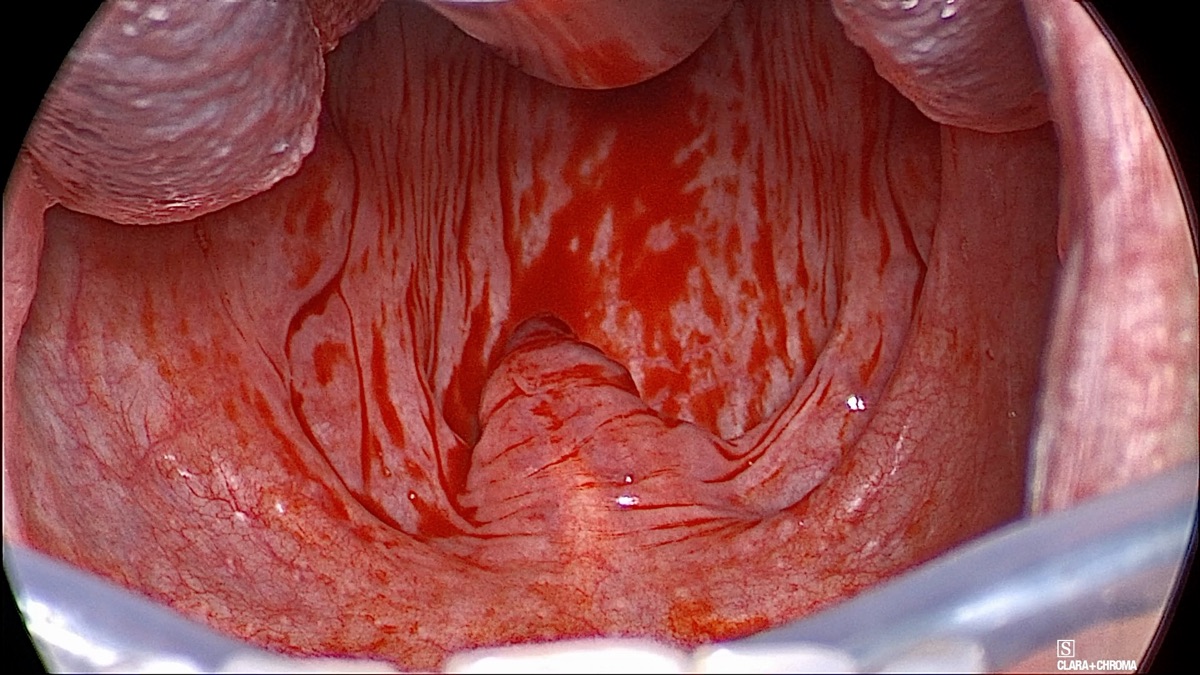
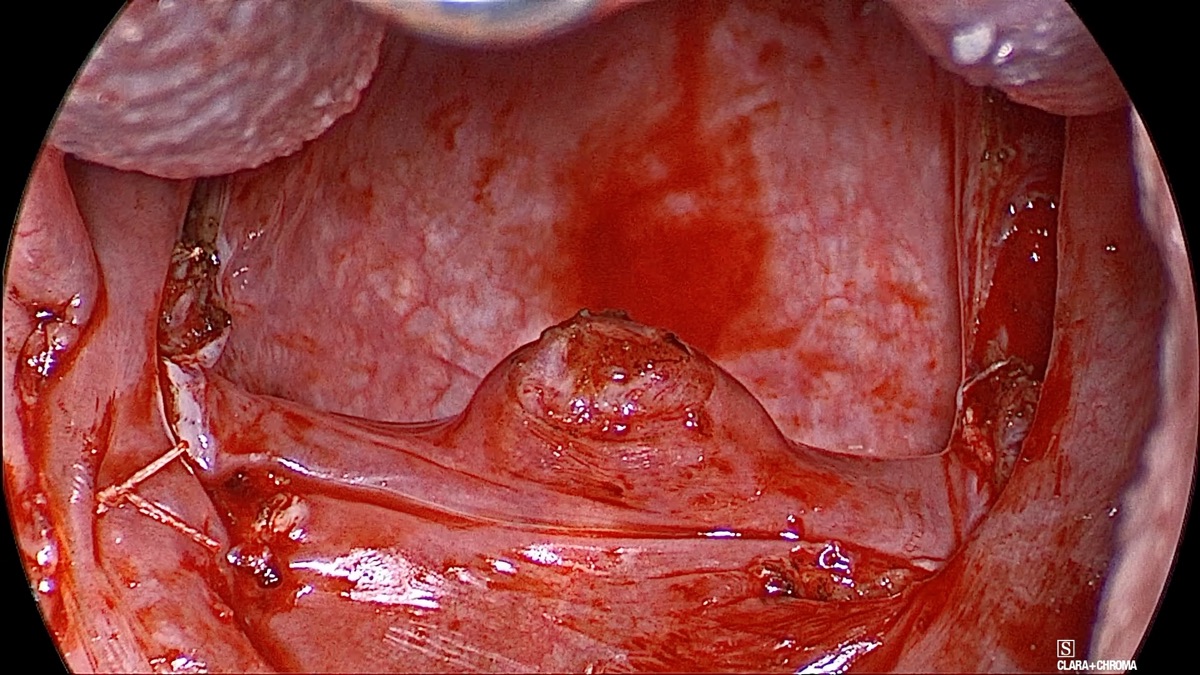
Individual anatomy and results vary; these images show the mechanical goal of the operation, not a guaranteed outcome.
Watching the operation, if you want to
Some people want to see exactly what is going to be done to them, and some people very much do not. Both are normal, and neither is the better patient. The footage below is a real barbed reposition pharyngoplasty from my own operating room, condensed to about two and a half minutes so you can follow the shape of the operation without sitting through all of it.
Content warning · real surgery This shows an actual operation inside the throat, including blood, raw tissue and sutures being passed. If you are squeamish, or you are about to have this surgery yourself and think it might unsettle you, it is completely reasonable to skip it. Nothing is lost by doing so. Show me the video Hide the video
The operation, condensed — about two and a half minutes
Everything happens through the mouth. In order, you will see:
- The soft palate and the sides of the throat after the tonsils have been removed
- The barbed sutures being passed through the soft palate and the side walls of the throat to move the muscles outward
- The wider space behind the palate at the end of the operation, closing with a before-and-after comparison like the photographs above
The video is condensed from a full operation, so steps that take minutes in the operating room pass in seconds here. There is no narration; the on-screen view is the surgeon’s view through the mouth.
Residents and surgeons: the complete operation is taught step by step, with the whole case on video, in the BRP surgical technique learning center.
Risks
Every operation has risks, and the two I spend the most time on with my own patients are these.
Bleeding. As with tonsillectomy, bleeding after throat surgery can occasionally be severe enough to require a return to the operating room for cauterization. Serious perioperative complications after palate surgery are uncommon — a national study of over 3,000 patients put serious complications at about 1.6%[18] — but you should know before the operation, not after, that a return to the OR is possible.
Suture extrusion. This one is very common, and it sounds worse than it is. A barbed suture end can partially work its way to the surface and tickle or poke in the throat as you heal. Expect roughly a one-in-five chance: the largest dedicated study, of 488 patients, found it in 18% of patients — about one in four with the suture type I use — and more than a third of the time it caused no symptoms at all.[22] A meta-analysis reports 18% as well; the first multicenter study counted just 6%.[9],[7] A systematic review of barbed pharyngoplasty complications found minor suture-related events were the most frequent issue reported, and serious complications were rare.[19] The fix is simple: you come back to clinic and we trim the excess suture in the office — no anesthesia, no operating room — and in the published data extrusion had no effect on the surgical result.[22]
The remaining profile, from the published literature: temporary difficulty swallowing is expected early (about one in five patients in the multicenter study, recovering within days there, though other series report it lasting longer),[7] a foreign-body sensation in the throat that fades as the sutures absorb, and less commonly a temporary nasal quality to the voice or brief moments of liquids coming back through the nose. Lasting problems with swallowing or speech — the complication that gave old-style UPPP its reputation — are substantially less common with muscle-preserving techniques. [3],[19]
Importantly, in the first several nights after palate surgery, home monitoring shows sleep apnea is often transiently worse before it gets better, while swelling peaks.[20] If you use CPAP, we plan for those nights together before surgery.
Recovery
Recovery takes at least two weeks, and I tell every patient the same thing: plan to take two full weeks off work. Patients report the pain peaking at 10 out of 10, and it can remain severe — requiring strong prescription pain medication — for up to two weeks. It is managed with alternating acetaminophen and ibuprofen on a schedule, prescription pain medication when needed, a soft diet, salt-water rinses, and sleeping with your head elevated. Residual twinges with yawning, sneezing or coughing can last up to a month; the tightness fades as the sutures absorb over about six months. My complete day-by-day instructions are in the downloads below.
After healing, we re-measure rather than assume: a follow-up sleep study documents what the surgery achieved, and in the staged pathway a repeat DISE re-examines the collapse pattern.[21]
Patient guide & post-op instructions
These are the exact documents I give my own patients — a plain-language guide to the procedure, and the postoperative instructions we review before you go home.
Common questions
Is barbed reposition pharyngoplasty the same as UPPP?
No. UPPP, the original 1981 operation, removed tissue — including the uvula and part of the palate. BRP repositions and tightens the existing muscles with barbed sutures instead of cutting them away, which preserves the palate’s function and is why classic UPPP is no longer the typical technique used today.
How long is recovery after BRP?
Plan on two weeks off work. Throat pain is significant for 10 to 14 days and is managed with scheduled alternating acetaminophen and ibuprofen, a soft diet, and salt-water rinses. Occasional twinges with yawning or sneezing can last up to a month, and the sutures themselves take about six months to fully absorb.
Do the barbed stitches come out?
They dissolve on their own over about six months. It is common — and harmless — for a small piece of suture to work toward the surface and tickle the throat while you heal; if that happens, the excess is simply trimmed in the office during a clinic visit, and in published series this did not affect the surgical result.
Can BRP make me a candidate for Inspire or Genio?
Often, yes — that is one of its most important uses. Complete concentric collapse on sleep endoscopy excludes hypoglossal nerve stimulation, but published studies report that palate surgery converts that pattern to a favorable one in most patients, after which a stimulator becomes an option. The full pathway is throat surgery first, then a repeat sleep study and repeat sleep endoscopy after healing.
How successful is BRP for sleep apnea?
In the largest prospective multicenter study, apnea events fell from a mean of 33 to 14 per hour, 73% of patients met the standard definition of surgical success, and 62% no longer required CPAP by a stricter definition. About a quarter of patients did not reach the success threshold, which is why careful candidate selection with sleep endoscopy matters.
References
Sources for every number on this page (AMA style)
- Fujita S, Conway W, Zorick F, Roth T. Surgical correction of anatomic abnormalities in obstructive sleep apnea syndrome: uvulopalatopharyngoplasty. Otolaryngol Head Neck Surg. 1981;89(6):923-934.
- Sher AE, Schechtman KB, Piccirillo JF. The efficacy of surgical modifications of the upper airway in adults with obstructive sleep apnea syndrome. Sleep. 1996;19(2):156-177.
- Tang JA, Salapatas AM, Bonzelaar LB, Friedman M. Long-term incidence of velopharyngeal insufficiency and other sequelae following uvulopalatopharyngoplasty. Otolaryngol Head Neck Surg. 2017;156(4):606-610.
- Browaldh N, Nerfeldt P, Lysdahl M, Bring J, Friberg D. SKUP3 randomised controlled trial: polysomnographic results after uvulopalatopharyngoplasty in selected patients with obstructive sleep apnea. Thorax. 2013;68(9):846-853.
- Pang KP, Woodson BT. Expansion sphincter pharyngoplasty: a new technique for the treatment of obstructive sleep apnea. Otolaryngol Head Neck Surg. 2007;137(1):110-114.
- Vicini C, Hendawy E, Campanini A, et al. Barbed reposition pharyngoplasty (BRP) for OSAHS: a feasibility, safety, efficacy and teachability pilot study. “We are on the giant’s shoulders.” Eur Arch Otorhinolaryngol. 2015;272(10):3065-3070.
- Montevecchi F, Meccariello G, Firinu E, et al. Prospective multicentre study on barbed reposition pharyngoplasty standing alone or as a part of multilevel surgery for sleep apnoea. Clin Otolaryngol. 2018;43(2):483-488.
- Neruntarat C, Khuancharee K, Saengthong P. Barbed reposition pharyngoplasty versus expansion sphincter pharyngoplasty: a meta-analysis. Laryngoscope. 2021;131(6):1420-1428.
- Saenwandee P, Neruntarat C, Saengthong P, et al. Barbed pharyngoplasty for obstructive sleep apnea: a meta-analysis. Am J Otolaryngol. 2022;43(2):103306.
- Friedman M, Ibrahim H, Bass L. Clinical staging for sleep-disordered breathing. Otolaryngol Head Neck Surg. 2002;127(1):13-21.
- Van de Perck E, Dieltjens M, Vroegop AV, et al. Concentric vs anteroposterior-laterolateral collapse of the soft palate in patients with obstructive sleep apnea. Otolaryngol Head Neck Surg. 2022;166(4):786-793.
- Castillo-Farias F, et al. Barbed suture pharyngoplasty in velopharyngeal complete concentric collapse: a multicentric study. Egypt J Otolaryngol. 2022;38:57.
- Hasselbacher K, Seitz A, Abrams N, Wollenberg B, Steffen A. Complete concentric collapse at the soft palate in sleep endoscopy: what change is possible after UPPP in patients with CPAP failure? Sleep Breath. 2018;22(4):933-938.
- Liu SY, Hutz MJ, Poomkonsarn S, Chang CP, Awad M, Capasso R. Palatopharyngoplasty resolves concentric collapse in patients ineligible for upper airway stimulation. Laryngoscope. 2020;130(12):E958-E962.
- Weidenbecher MS, Vargo JW, Carter JC. Efficacy of expansion pharyngoplasty and hypoglossal nerve stimulation in treating sleep apnea. Am J Otolaryngol. 2022;43(5):103592.
- Patel PA, Munhall CC, Smith CD, et al. Airway changes after sleep apnea surgery using drug-induced sedation endoscopy: a systematic review and meta-analysis. Otolaryngol Head Neck Surg. 2026;174(1):17-29.
- Suurna MV, Lopez B. Should adjunct palatopharyngeal surgery be performed with hypoglossal nerve stimulation for OSA treatment? Laryngoscope. 2026;136(1):22-23.
- Kezirian EJ, Weaver EM, Yueh B, et al. Incidence of serious complications after uvulopalatopharyngoplasty. Laryngoscope. 2004;114(3):450-453.
- Moffa A, Giorgi L, Cassano M, et al. Complications and side effects after barbed pharyngoplasty: a systematic review. Sleep Breath. 2023;27(1):31-41.
- Yu PK, Wong V, Cook K, Huyett P. Immediate postoperative changes after expansion pharyngoplasty and hypoglossal nerve stimulation. Laryngoscope. 2025;135(5):1836-1842.
- Iannella G, Pace A, Magliulo G, et al. International expert consensus statement: surgical failure in obstructive sleep apnea. Sleep Breath. 2024;29(1):38.
- Gulotta G, Iannella G, Meccariello G, et al. Barbed suture extrusion and exposure in palatoplasty for OSA: what does it mean? Am J Otolaryngol. 2021;42(4):102994.
Disclosure: I have served as a consultant for Inspire Medical Systems. I have received research support from Nyxoah (maker of Genio) and have been a paid member of the clinical events committee for Nyxoah-sponsored trials, including ACCCESS and BREATHE. Those two companies make the hypoglossal nerve stimulators discussed in the staged-treatment pathway on this page. I have no financial relationship with any maker of barbed sutures or pharyngoplasty instruments, and no manufacturer had any role in this page’s content.